“Medium != Message…”

Truthbomb via Analog Industries

One thing I’ve often said, when confronted with the type of person that gets in to the minutia of the recording process, perhaps at the expense of the big picture, is that a good song will survive any production process, while a bad song can’t be saved by the most sophisticated gear and recording techniques available.

This sort of idea is anathema to the Gear Queer, who is always certain that there is that one more piece of kit sitting out there, just beyond grasp, that will push things over the edge and make all the difference. We’re each of us guilty of this behavior, of course. Let he who is without sin cast the first stone, etc. But the simple fact of the matter is that the work of art exists already, as a wave function, and whatever you need to collapse that bitch and bring shit out in to the cold light of day is what you need. There are records that wouldn’t exist without a massive, and relatively expensive, modular synth and a fairly detail-oriented production approach (see: A Funneled Stone), and others that would sound fucking retarded if they were anything but a guitar and a vocal. (See: Robert Johnson’s entire ouvre. Happy 100th b’day to Mr. Johnson, btw.)

Now, this entire approach could be perceived as my own way of justifying my several rather ridiculous recording habits, the which you’re all perfectly aware of. I approach photography and music-making in the same way, trying to squeeze something interesting out of a device not really meant to do what I’m asking of it, largely via a trial-and-error approach rather than any cohesive planning on my part. My general philosophy with respect to photography is the Shakespeare/Monkey method: if you take enough pictures, some of them are bound to be interesting, and quantity has a quality all its own. No particular reason this can’t be applied to music. (See: Wesley Willis.)

I guess what I’m trying to say, when it comes down to it, is this: I am of the firm opinion that there is interesting shit hiding in my brain. All I have to do is figure out how to get it out. While a new piece of The Shiny might make certain aspects of that chore easier, at the end of the day, the song lives in my brain, not in the gear. The medium is the messenger, not the message itself.
Poisoned Tracks

Like everyone else yesterday, I downloaded the iPhone Tracker app and peeked into the cached location database.

Iphone location

Nothing too unexpected (there’s a cluster of NYC data too), but I quickly noticed some spurious data. Specifically the cluster of data at Edwards Air Force Base (just to the left of the lake in the center) and the scattered plots just south of CA-58 in the Tehachapis. I figured that the location data was cached cell tower locations instead of GPS tracks which today’s follow-up stories seem to confirm. A Ihnatko commenter nails it:

Second:
Look at the timestamps on the data: rows occur as big clumps with IDENTICAL timestamps, ranging over a wide region. It’s not saying you were in a couple dozen locations all at once; it’s listing off all the visible cells (and their estimated locations, and the quality of the estimates) at a particular instant.

That’s the real reason you see data points in places you haven’t been: it’s not an artifact of the imprecision of cell triangulation. It’s one of the cells that was used *for* triangulation; i.e., your phone was able to detect a faint signal from a cell site at that approximate location.

Third:
Scroll back in time in the tracker tool, to the earliest weeks around home. (Helps if you choose a week when you didn’t travel anywhere). They’re probably almost empty, and the few data points that exist are in outlying areas you haven’t been to. Is this because you weren’t using your shiny new iPhone much in the first few weeks? Of course not! It’s because every other cell that was seen at that time has been observed again, more recently — so the corresponding row has been updated with a more recent timestamp. The remaining points for those weeks from long-ago represent the few cells that your phone *hasn’t* seen since then.

Apple isn’t trying to keep a location history at all; that’s just a side-effect of the thoroughness of this cell location caching.

Yes, in nefarious hands, this data can be used to track past locations — but only on the order of showing the most recent time your phone visited a given city. For a wide and frequent traveller, this could be upsetting. For someone that mostly sticks to just a few cities, the database reveals practically nothing.

To be fair, Android phones also caches location in a similar way (and there’s an app to read it out). so ease down on the “Big Steve Is Watching You” paranoia, but I got to wondering…

Could a location cache with false data be written to the phone? Could these location caches be introduced as evidence if regular call log/cell tower information is unavailable? How soon until someone devious enough frames a mark by changing the phone files to indicate that they were someplace they weren’t.

If you use this idea in a screenplay, I’ll only charge a modest 8%.

Raw Power

A freak storm hit the Sonisphere Festival in Finland last August and knocked down the stage and put the rest of the festival into complete disarray. Here’s what happened next:

A freak thunderstorm that unexpectedly blew in from the Baltic Sea threatened to uproot Sonisphere Finland, but the bands, the crew and just as importantly the fans all pulled together and ensured the show went on. It was a true team effort. The biggest concern was the injuries sustained by some of the crowd. Thankfully the two people most seriously injured are no longer critical.
The storm lasted less than five minutes, but in that time it damaged the second stage beyond repair (it’s currently being held up by a crane), completely broke Mötley Crüe’s kit and soaked absolutely everyone at the festival. It was so bizarre you’d be tempted to believe Thor not to be outdone by the noise levels being produced by Anthrax and Slayer earlier in the day had a hand in it.

As Bruce Dickinson said on stage as he gave a rallying call to the crowd and introduced Alice Cooper: “The stage over there is completely fucked. Mötley Crüe have gone home as their stuff is fucked and our stuff is fucked, but we don’t care. We’re not going home until you go home.”

Iggy Pop was the first artist to get back up on stage. “We’re a small part of the fucking Stooges,” he said before playing an impromptu four-song acoustic set with his guitarist . For ‘I Wanna Be Your Dog’ he invited his saxophone player up on stage, holding his mike to the horn for amplification. It was something you are unlikely to ever witness again in front of a festival crowd and it blew people away. Slayer drummer Dave Lombardo was almost speechless afterwards: “That was. fucking phenomenal, really, really awesome and when the sax came out, well…”

I was really hoping that the Stooges set would turn up on YouTube, and lo and behold:

Punching the clock in orbit

This photo of has getting a bit of attention lately and rightly so – it’s something straight off of a 90s-era science fiction book cover. Post-cyberpunk optimism was back for a bit before blowing apart into lots of little subgenres.

iss_cupolaview.jpg

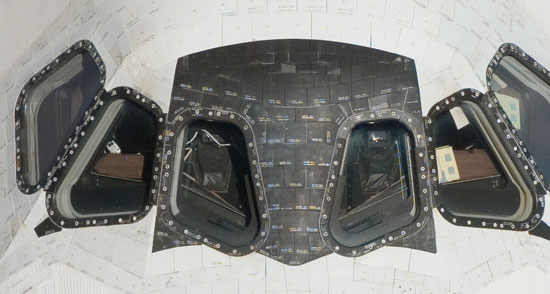
But I have always liked this photo of Endeavour back on STS-123 in 2008. No posed photo-op here, just a photo of a work truck complete with a clipboard and iPod left on the dashboard. Only thing missing here is a old cup of coffee and a badly-folded map but I suspect the astronauts have that covered.

shuttle_ipod.jpg