 There’s a bucketload of obituaries on the net and I wager that at least 90% of them contain the phrase “drug addled” or some sort of variation. I know I shouldn’t be surprised by that, but that casual dismissal grates on me. Yes I know that Syd was(is) It Guy Number One for the psychedelic phase of Swinging London and yes, part of the price paid for being that icon is a heroic consumption of drugs of all variations. And OK sure, drugs played a part in exacerbating his already erratic behavior. We all know the stories and Syd’s life is as fundamental to the rock-and-roll bedrock as Brian Wilson’s sandbox or Keith Moon’s hotel room. My objection to the cautionary tale of “creative genius takes drugs, never creates again” is the implied passive-aggressive outrage. As if there’s some kind of creator/consumer trade deficit. How dare this guy check out of being a pop star, after all we’ve done for him!
I think all of us were secretly hoping or even expecting that Syd would have eventually returned. Maybe not a gig, but probably a public “thank you for all your support” or something. There’s precedent too: Peter Green showed up after years in the wilderness and after all kinds of improbabilities, Brian Wilson finished and performed Smile. I remember back in the 90s there was a rumor that R.E.M. had offered a million dollars to Syd if he would enter a recording studio again, even if nothing was released. Just a couple years ago, after years of non-recognition and acknowledgement, reclusive painter Roger Barrett signed a book of vintage-era photographs of himself as “Syd.”
A return would have been just too neat of an ending and ultimately Syd left us with no answers at all – only questions encoded into a couple hours’ worth of music. Still, what a catalog: top pop songs, ultra-experimental abstractness, furious garage rock, children’s lullabies – enough rocket fuel not just for Pink Floyd, but the countless others that plugged into it. No wonder McCartney was sniffing around the door of Abbey Road during the recording of The Piper At The Gates Of Dawn. Yesterday, I listened to “See Emily Play” and after 1.23E+11 listens I’m still hearing new things in it (just how loud is that electric guitar in the break before the last chorus?). Even b-side “Candy And A Currant Bun” would be enough to be the centerpiece of an entire album of Nuggets material.
Ultimately though, once you get past the songs you bonk up against the same questions that dog analysts of any artist who’s critical breakthrough runs concurrent with mental breakdown. Which drives which? Syd himself was the closest on-scene narrator despite layers of unreliability. There’s not much in the way of spiritual narratives, quests for enlightenment, or an occasional door of perception. Syd wrote about himself and how he perceived the world, each time adding some layer of unreality to it like Louis Wain’s famous progression of increasing psychotic cat paintings. Hmmm… Syd wrote a song about a cat too.
Being a pop star isn’t exactly congruent with undiagnosed acute schizophrenia though and it seems like the deck was stacked against Syd from the beginning. To address the annoying “acid casualty” phrase again, I can’t help but wonder if Syd was really trying to chemically address a reality that was rapidly slipping through his fingers. He seems sad in this clip, or maybe just annoyed from having to answer such hostile questions.
I’m not quite sad, but maybe melancholy. There’s always the records and they still mean as much to be now as they did twenty-six years ago when I plunked the needle down on “Astronomy Domine” and shouted “WHATTHEHELLISTHAT!?” I’m angy at the thought of knowing that there are some twats out there who are saying “Dude, let’s do shrooms on Syd’s grave!” I hope that he found some sort of peace and equilibrium with the world and it’s the world’s duty to let him enjoy it. In the meantime there’s a wonderful set of puzzles left behind. RIP.

 I had no idea that folks had found meteorites at the desert Silver Lake. Best I was ever able to do was this wreckage of an indeterminate-looking car embedded in the playa.
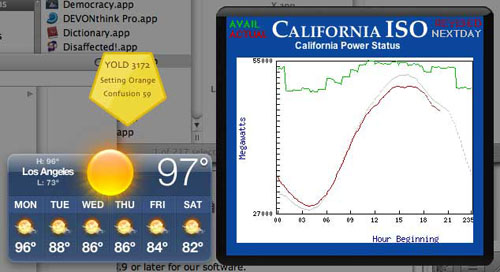 I found a combination of Dashboard widgets that make sense for the Current Situation – the basic weather widget and the


